


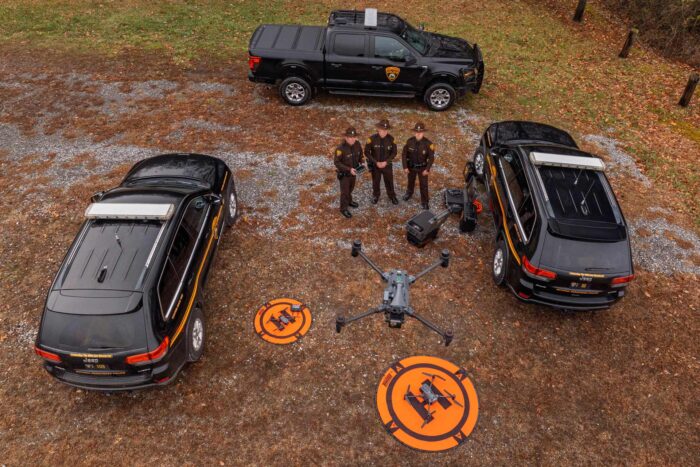

How the WVDNR Drone Program Started
Natural resources police officers at the WVDNR started a drone program as a practical solution to the long-standing challenge of assessing black bear damage in agricultural fields. Traditionally, NRPOs had to walk entire cornfields to locate and measure crop damage. This process could take an entire day and still miss significant areas.
One day, NRPO Josh Prickett offered to use his personal drone to survey a field and the rest is history. Since then, drone imagery has helped the WVDNR provide:
- Fast, accurate field assessments
- Clear documentation for transparent reimbursements to farmers
- Save time and money for officers and the agency
This success prompted the WVDNR to invest in its first fleet of drones, laying the foundation for what is now a versatile, statewide program.
Growth Into a Statewide Public-Safety Tool
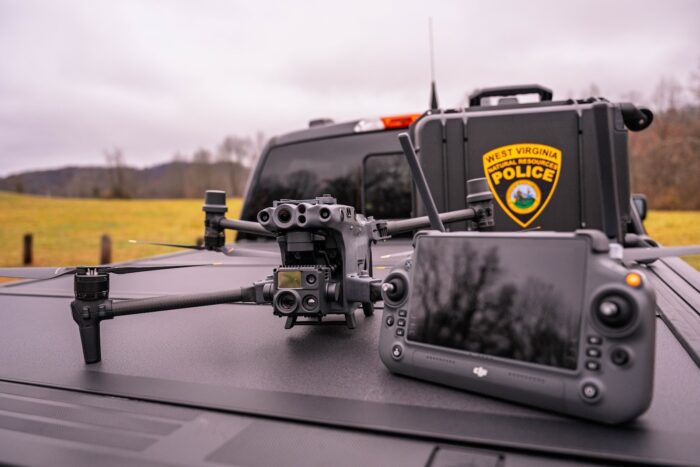
As technology advanced, so did the scope of the WVDNR’s drone program. What started as agricultural assessment quickly evolved into a critical tool for search and rescue, evidence recovery and disaster response. The recreational drones first used by the agency have now been replaced with state-of-the-art drones with the following advanced capabilities:
- Thermal/infrared imaging for night searches and heat signature detection
- High-zoom optical cameras
- GPS-based flight tracking and geofencing
- Lights and mounted speakers for communication during emergencies
- Payload systems, including grapplers that can deliver life jackets or ropes during swiftwater rescues
- Modular batteries that enable nearly continuous flight through rapid swap systems
These features allow NRPOs to respond faster, safer and more effectively, reducing or eliminating the need for expensive helicopter support.

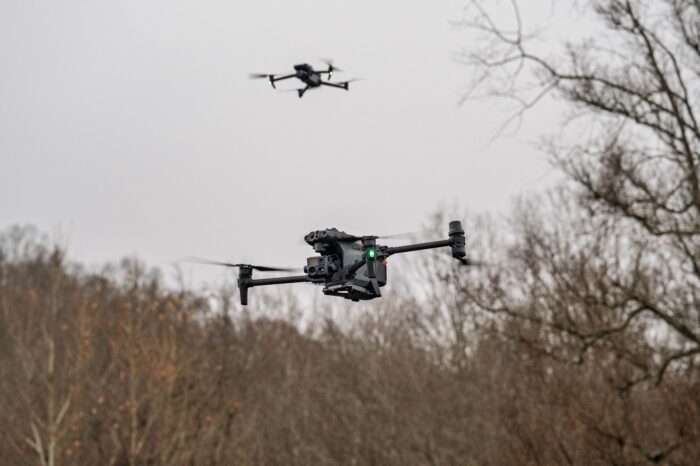
Search and Rescue: Saving Lives in Rural West Virginia
The WVDNR’s drone program has already played a vital role in locating missing persons across West Virginia’s rugged landscape. Examples of real usage include:
- Locating lost hikers in remote areas such as Dolly Sods
- Guiding officers to elderly individuals with dementia who wandered from home
- Finding missing children before conditions deteriorate
- Identifying stranded individuals during flood events
- Detecting heat signatures of people or wildlife hidden beneath heavy brush
Drones allow NRPOs to put “eyes in the sky” within minutes, which is critical in life-or-death situations where waiting hours for a helicopter to be available is not an option.
Crime Scene and Evidence Recovery
Drones now support investigations statewide, helping officers:
- Locate hidden firearms or evidence discarded in the woods
- Track habitual poachers who flee from officers
- Identify poached game hidden under brush or cover
- Assist canine units by scanning ahead along a track to narrow search zones
Thermal technology can detect heat signatures from wildlife or people more than a day after the event, which dramatically reduces time spent searching dense terrain.
Swiftwater and Flood Response
NRPOs are responsible for protecting the state’s waterways, and drones are now a core part of their swiftwater rescue operations. During floods, drones help NRPOs:
- Assess water flow, hazards, and safest rescue routes
- Locate stranded individuals on rooftops, vehicles, or trees
- Communicate via onboard speakers when rushing water makes shouting impossible
- Deliver life jackets or rope-and-harness systems using drone-mounted grapplers
- Guide swiftwater rescue teams by scouting the river ahead of them
This rapid aerial assessment keeps officers safer and increases the chances of successful rescues.
Training, Certification and Compliance
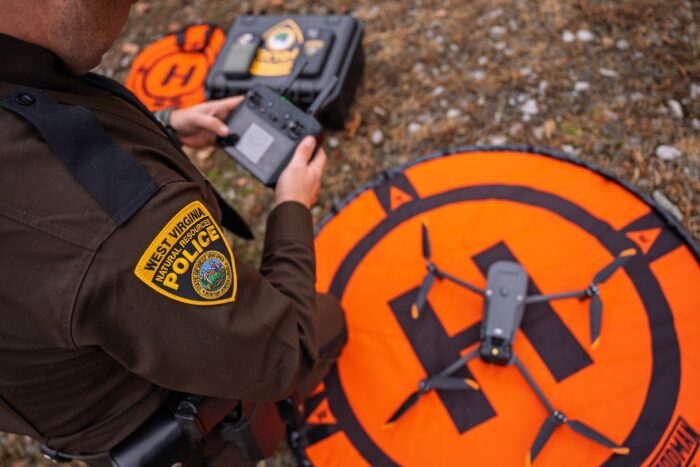
Because drones are considered aircraft, the FAA heavily regulates their use. The WVDNR’s Law Enforcement Section has taken a rigorous approach to compliance and certification.
All drone pilots must:
- Obtain FAA remote pilot certification
- Undergo agency-specific training on flight safety, equipment and operational procedures
- Follow FAA rules for airspace, no-fly zones and GPS-identified drone registration
- Maintain strict safety protocols to protect the public and avoid equipment loss
The WVDNR currently has 13 certified drone pilots statewide, overseen by a dedicated drone program coordinator.
Integration With Other Special Teams
The WVDNR’s drone program supports and enhances other programs and operations, functioning as a force multiplier for:
- K9 teams (tracking, evidence recovery, poaching cases)
- Swiftwater rescue specialists
- Wildlife damage control operations
- Emergency management partners
- Local fire departments, sheriff’s offices, and police agencies
Because West Virginia is a rural state, this technology ensures officers can respond effectively even in remote or hard-to-reach areas.
What Sets the Program Apart
The WVDNR Law Enforcement Section has a long history of staying on the cutting edge and adopting the best tools, technologies and training to protect West Virginia’s people, wildlife and public lands. The drone program is a natural extension of that forward-thinking mindset. Rather than waiting for solutions to arrive, the agency continually innovates to make officers more effective, communities safer and emergency response faster.
The WVDNR’s drone program stands out because it:
- Directly improves public safety and saves lives
- Reduces costs for farmers and agencies
- Modernizes evidence-gathering and enforcement
- Strengthens partnerships with statewide emergency responders
- Adapts rapidly to new technology and challenges
- Helps protect West Virginia’s natural resources and people
And as technology continues to evolve, the WVDNR remains committed to leading the way and setting the standard for modern conservation law enforcement by advancing the tools, skills and innovation needed to protect West Virginia for generations to come.