
What is Chronic Wasting Disease?
CWD is a neurological (brain and nervous system) disease of the deer family known to occur in limited geographical locations in North America and Europe. The disease belongs to a family of diseases known as transmissible spongiform encephalopathy (TSE). These diseases are caused by an abnormal form of a protein called a prion. There is no practical test of live animals to detect CWD, and there is no known treatment or vaccine. Postmortem testing is necessary for definitive diagnosis.
How is it spread?
It is thought that the most common mode of transmission from an infected animal is via saliva, feces, urine and possibly other body secretions. The infectious prion persists in the environment. There is evidence that people moving live infected animals have spread the disease over long distances.
Is it dangerous to humans?
There currently is no convincing evidence that the agent of CWD affects humans. However, public health officials recommend that human exposure to the CWD agent be avoided as they continue to research the disease. This includes not eating meat from known infected animals or animals that appear sick.
Where has it been found?
As of April 15, 2026, CWD has been detected in free-ranging deer and elk in portions of Alabama, Arkansas, California, Colorado, Florida, Georgia, Idaho, Illinois, Indiana, Iowa, Kansas, Kentucky, Louisiana, Maryland, Michigan, Minnesota, Mississippi, Missouri, Montana, Nebraska, New Mexico, New York, North Carolina, North Dakota, Ohio, Oklahoma, Pennsylvania, South Dakota, Tennessee, Texas, Utah, Virginia, Washington, West Virginia, Wisconsin and Wyoming in the United States, and in Alberta, British Columbia, Manitoba and Saskatchewan in Canada. In addition, CWD has been found in captive/farmed elk and white-tailed deer in Colorado, Idaho, Illinois, Iowa, Kansas, Kentucky, Louisiana, Michigan, Minnesota, Mississippi, Missouri, Montana, Nebraska, New York, Ohio, Oklahoma, Pennsylvania, South Dakota, Texas, Utah, West Virginia and Wisconsin in the United States, and Alberta, Quebec and Saskatchewan in Canada. Outside of North America, CWD has been found in wild moose in Finland, Norway, and Sweden, in European reindeer in Norway, and in captive elk in South Korea.
In West Virginia, CWD has been found in 902 white-tailed deer. Testing of road-killed deer in all West Virginia counties has been continuous since 2002. The WVDNR’s Wildlife Resources Section, in cooperation with various USDA certified laboratories, has tested more than 24,654 deer from West Virginia for CWD. As of April 15, 2026, 737 deer from Hampshire County, 39 from Hardy County, 63 from Berkeley County, 22 from Mineral County, 27 from Morgan County, 13 from Jefferson County and one from Grant County are the only animals found thus far to have the abnormal prion associated with CWD.
What is being done about CWD in West Virginia?
CWD in West Virginia represents a significant threat to the state’s white-tailed deer. The disease does not create an immediate widespread die-off of deer, but if allowed to spread, will cause long-term damage to the herd. The WVDNR is monitoring the prevalence and distribution of the disease in the areas surrounding known infected deer. The WVDNR also discourages supplemental feeding and baiting of deer statewide, bans these practices on public land, and also bans these practices anytime in Berkeley, Grant, Hampshire, Hardy, Jefferson, Mineral, Morgan and Pendleton counties. In addition there are restrictions on the disposal and transport of deer carcasses from Berkeley, Grant, Hampshire, Hardy, Jefferson, Mineral and Morgan counties within the West Virginia containment area (see CWD containment area) and any deer brought into West Virginia from states where CWD has been detected or from fenced enclosures. There are no proven solutions to combating CWD once present in free-ranging deer. Thus, future management actions will be adaptive and based on the findings of current and future surveillance.
CWD Containment Area
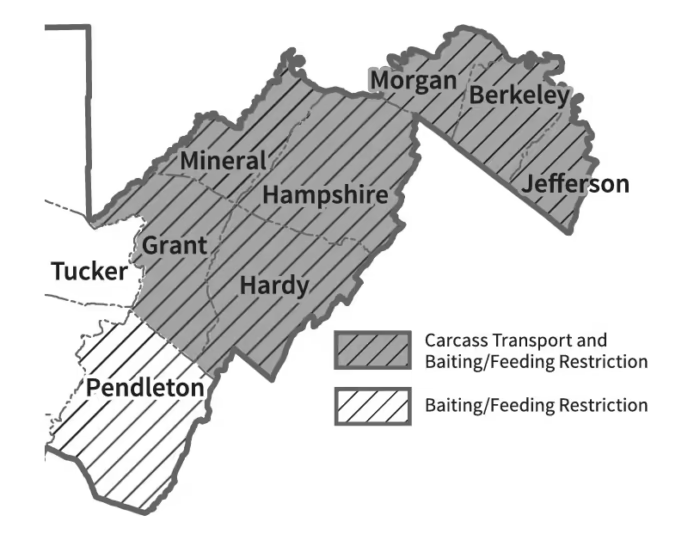
Includes all of Berkeley, Grant, Hampshire, Hardy, Jefferson, Mineral, Morgan and Pendleton counties (cross hatch counties at right). It is illegal to bait or feed deer any time in the “Containment Area” (see baiting and feeding regulations on page 14). In addition, hunters are prohibited from transporting dead deer or their parts beyond the boundary of Berkeley, Grant, Hampshire, Hardy, Jefferson, Mineral and Morgan counties (shaded counties at right) within the containment area except for the following: meat that has been boned out, quarters or other portions of meat with no part of the spinal column or head attached, cleaned hide with no head attached, clean skull plate (no meat or tissue attached) with antlers attached, antlers with no meat or tissue attached, and finished taxidermy mounts. Hunters may transport cervid carcasses that were not killed inside the containment area through the containment area.
What can hunters do?
If you kill or observe a severely emaciated (very skinny) deer or a deer that is obviously sick, or a deer with an ear tag, contact the WVDNR Wildlife Resources Section office nearest you.
- Do not feed or bait deer. These practices concentrate deer, increase the likelihood of spread of any disease present in the deer herd, and may introduce foreign contaminants via the feed or bait.
- Harvest adequate numbers of antlerless deer to maintain deer populations in balance with natural food supplies. A deer population in balance with available habitat is healthier and less likely to spread diseases.
- Avoid using natural deer urine based lures in the environment and do not place these urine lures on the ground or on vegetation where deer can reach them.
- If you hunt cervids (deer, elk, moose, etc.) out of state bring back only boned-out meat or quarters and thoroughly cleaned skull plates, hides, antlers and/or finished taxidermy mounts. This applies to all CWD-positive states, except for VA, MD, OH and PA where it applies only to the state designated CWD containment area or CWD disease management areas.
- If you hunt in Berkeley, Grant, Hampshire, Hardy, Jefferson, Mineral or Morgan counties, see special regulations regarding carcass transport and disposal. Disposal of carcass waste by double-bagging and landfill is preferred if the animal is not quartered in the field. Do not dispose of carcass waste by dumping where other deer may come in contact with it.
- If you kill a cervid out of state in a fenced enclosure, only boned out meat or quarters and thoroughly cleaned skull plates, hides, antlers and/or finished taxidermy mounts may be transported into the state.