
2025 State Wildlife Action Plan
The West Virginia State Wildlife Action Plan (SWAP) is a response to Congress’s challenge for all states to provide a comprehensive wildlife conservation strategy, but more importantly, it is a road map for the West Virginia Division of Natural Resources (WVDNR) and its many partners and collaborators to proactively conserve the full array of West Virginia’s biological diversity.
West Virginia is rich in natural resources and its citizens deeply value fish and wildlife. This conservation plan addresses the complex challenges facing over 600 animal and 400 plant “Species of Greatest Conservation Need” (SGCN). These species, like many others, rely on suitable habitat, which is threatened by loss, degradation, disease, competition, and predation across multiple scales. Moving beyond regulation, this plan promotes a collaborative, voluntary approach, engaging landowners, agencies, NGOs, researchers, and the public.
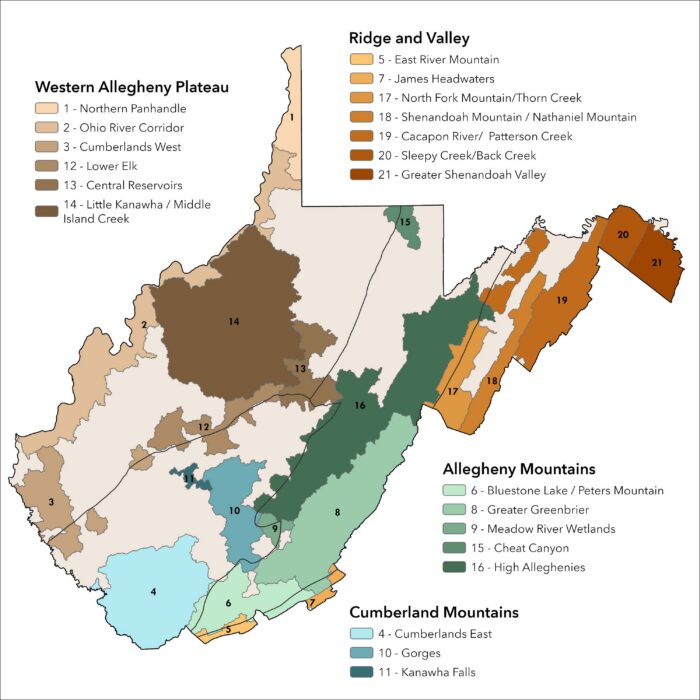
2020 Conservation Focus Area Action Plans
- 1. Northern Panhandle CFA Action Plan
- 2. Ohio River Corridor CFA Action Plan
- 3. Cumberlands West CFA Action Plan
- 4. Cumberlands East CFA Action Plan
- 5. East River Mountain CFA Action Plan
- 6. Bluestone Lake and Peters Mountain CFA Action Plan
- 7. James Headwaters CFA Action Plan
- 8. Greater Greenbrier CFA Action Plan
- 9. Meadow River Wetland CFA Action Plan
- 10. Gorges CFA Action Plan
- 11. Kanawha Falls CFA Action Plan
- 12. Lower Elk River CFA Action Plan
- 13. Central Reservoirs CFA Action Plan
- 14. Little Kanawha River and Middle Island Creek CFA Action Plan
- 15. Cheat Canyon CFA Action Plan
- 16. High Alleghenies CFA Action Plan
- 17. North Fork Mountain and Thorn Creek CFA Action Plan
- 18. Shenandoah and Nathaniel Mountain CFA Action Plan
- 19. Cacapon River and Patterson Creek CFA Action Plan
- 20. Sleepy Creek and Back Creek CFA Action Plan
- 21. Greater Shenandoah Valley CFA Action Plan