
West Virginia is home to an array of creatures that depend on the darkness of the night sky for mating, navigation, and survival. However, our nighttime skies are increasingly brighter. Learn more below about Artificial Lights At Nights and actions we can take to decrease our outdoor light usage for the species we care about.
What is ALAN?
Artificial Lights At Night (ALAN) is a common term used to describe light pollution. There are 5 widely recognized types of light pollution:
- Over-illumination: Excessive light, beyond what is needed for a particular task and constitutes energy waste. Think of an empty parking lot with lights left on all night.
- Skyglow: Brightness of the night sky over an area.
- Glare: Excessive brightness that leads to overall reduced visibility.
- Light trespass: Unwanted light that falls where it was not intended to. For instance, a neighbor’s porch light shining through a bedroom window.
- Clutter: Groupings of bright, disorganized light form an artificial light source. Think of city strips with groupings of neon signs.
Over the last several decades, ALAN has been increasing and it is expected that this trend will continue. Light pollution affects bats, insects, migrating birds, and perhaps things you may not think of, such as plant growth. The good news is that there are some simple actions you can take to reduce ALAN and help our darkness-dependent wildlife.
Wildlife Impacts of ALAN?
Birds
Artificial light at night (ALAN) harms birds where they live and during migration. For resident songbirds, ALAN disrupts life in many ways, and disruptions increase with light intensity. Night lighting extends waking hours: getting up earlier, roosting later, and foraging longer. The light interferes with birds’ sleep, suppressing production of melatonin and elevating metabolic rates. Carolina wrens and Northern cardinals have been found to have smaller eyes where nights are illuminated. Lighting at night has also been shown to lower levels of reproductive hormones, prompt birds to initiate nesting earlier, and reduce survival rates for gray catbirds and Northern house wrens. ALAN also expands opportunities for predation, both by diurnal and nocturnal predators.
Migratory birds face additional challenges from ALAN. Night lighting interferes with length-of-daylight cues, prompting northward-bound birds to depart their breeding grounds prematurely. Migrating birds navigate using the sun, the stars, and the earth’s magnetic field; ALAN disrupts their processing of all three of these signals. Disoriented birds may circle bright lights in the sky and collide with structures or guy wires; communication towers can be particularly lethal. ALAN draws migrants off-course; juveniles are thought to be especially susceptible. Drawn by skyglow, exhausted migrants settle into hostile urban environments, where food and water are scarce, buildings and glass lure them into deadly collisions, and outdoor cats and other predators prowl.
Fireflies
Apart from daytime fireflies like the Winter Firefly and Woodland Lucy, fireflies depend on darkness to see and respond to bioluminescent mating signals. Like bird calls, fireflies have a flash pattern unique to their species that is used for mating. However, if it is not dark enough, mates may not be able to see each other’s flashes. Imagine yourself trying to call out a friend’s name in a crowd; if it is too loud, they will not be able to hear the call. Not only does ALAN interfere with the ability of males and females to see each other, but interrupts mating rituals for species whose males synchronize, such as the Synchronous Firefly. ALAN is no surprise in developed areas but is not absent in rural areas. The rise in popularity of bright LEDs, and “dusk to dawn” lights presents an obstacle in mating even in the countryside. Over the last several decades, the intensity of ALAN has increased, coinciding with reports of a decline in firefly numbers. Some entomologists believe they are linked.
Glow-worms and Gnat larvae
Like fireflies, other glowing nighttime insects can be affected by ALAN. Female glow-worms (Phengodes), sometimes referred to as railroad worms, can be found on the forest floor and trail margins glowing to attract mates. Male glow-worms use females’ glow as a beacon for long-range detection and their large antennae for close range detection. ALAN may interfere with males’ ability to find females from further away. Appalachia is also home to Orfelia fultoni, a species of glowing gnat larvae that is distantly related to the famous bioluminescent creatures of Waitomo cave in New Zealand. Sometimes referred to as the Foxfire Fly or “dismalites”, these carnivorous gnats spin webs and glow to attract prey. Light exposure disrupts these behaviours, affecting their ability to find dinner.
Moths
Moths are important pollinators of many types of plants. They are also very famously drawn to artificial lights. Testing suggests that moths’ navigate using natural light from the sky, such as the moon and stars. Moths likely use natural sky light to tell them which way is up, similar to how humans use gravity to tell them which way is up. ALAN disrupts moths’ natural navigation system, and makes it difficult for them to travel safely. They can spend all of their energy circling lights through the night, dying from exhaustion or starvation. Bats and birds target artificial lights, because they know that moths are drawn to them, and can eat large numbers of moths before they have a chance to reproduce. Likewise, moths can be so confused by ALAN that they are unable to find mates. Additionally, large, hot lights can simply burn moths to death on contact. With large numbers of moths perishing as a result of ALAN, heavily impacted areas can see shifts in moth communities, with some species becoming more uncommon. Since a single moth can lay hundreds of eggs, caterpillars, an important food source for many birds, can decline in numbers as well.
Crayfish
Crayfish are primarily nocturnal. During the daytime, most species of crayfish are likely to be found sheltering themselves under rocks or within burrows to avoid predation. At night, these crayfish species will emerge to graze, interact with other crayfish, and work on their burrows and shelters. These behaviors displace sediment from aquatic ecosystems and create habitat for other species. Crayfish play an important role as ecosystem engineers and serve as a crucial food resource for other organisms in their ecosystems. Artificial light at night (ALAN) has been shown to disrupt the behavior of nocturnal crayfish, increasing sheltering behaviors and reducing grazing, interactions with other crayfish, and beneficial ecosystem engineering behaviors. Increased light pollution can also give visual predators a leg up, leading to increased crayfish predation.
Mammals
Bats
These nocturnal creatures are known for their reliance on echolocation over eyesight to catch their prey, so it may come as a surprise that bats are affected by ALAN. When the sun goes down at twilight, bats begin to emerge from their roosts to feed. Bright lighting near roosting sites can confuse a bat’s sense of time and delay emergence, which leaves them with less time to feed. All 14 bat species recorded in West Virginia are insectivores, and some of the more light-tolerant species will use the insect attractant properties of artificial lighting to increase the odds of catching their prey. This strategy comes with risks, however, as it makes those bats more vulnerable to becoming prey themselves for predators such as owls and hawks. The forest-adapted bat species often avoid brightly illuminated areas altogether, which functionally fragments their habitat with barriers of light between roosting and feeding areas.
Shrews
Shrews are insect-eating small mammals that spend much of their time hidden beneath leaf litter, soil, or vegetation. Though small in size, these animals have an extremely high metabolism which requires them to feed frequently to survive, with some species starving in as little as 4 hours. At night, these primarily fossorial species venture to the surface to forage. The nighttime darkness helps cloak a foraging shrew from potential predators like owls, foxes, and raccoons. In lit areas, shrews may not be able to safely venture out at night, which leads to reduced feeding opportunities and increased risk from visual predators. Many of the shrew’s predators have such high visual acuity that even subtle changes in lighting around homes, roads, and campsites can increase predation risk.
Allegheny Woodrats
The Allegheny Woodrat is a rare Appalachian rodent that can be found in rocky outcroppings, cliffs, and mature forested ridges in West Virginia. Woodrats typically leave their dens shortly after sunset to forage for fruits, seeds, and other plant materials, using the cover of night to protect them from predators. Studies on nocturnal rodents have shown that ALAN is associated with reduced foraging activity and increased time spent sheltering and hiding. For a species already facing threats from habitat fragmentation and disease (raccoon roundworm), artificial lighting near cliffs, roads, and recreation sites further limits safe opportunities for woodrats to feed and move between habitat patches.
Plants
Like wildlife, plants take their cues from the environment. Environmental variables, such as temperature and duration of sunlight, give plants the cues they need to begin flowering, budding, or letting go of their leaves (senescence). However, ALAN may interrupt the photoperiods (daily duration of light exposure) of some plant species, potentially leading to unwanted consequences such as delayed leaf senescence, earlier budding, and different daily and seasonal flowering times. These changes do not only affect the plants themselves, but additionally the wildlife and insects depending upon the resources of these plants!
West Virginia’s Role
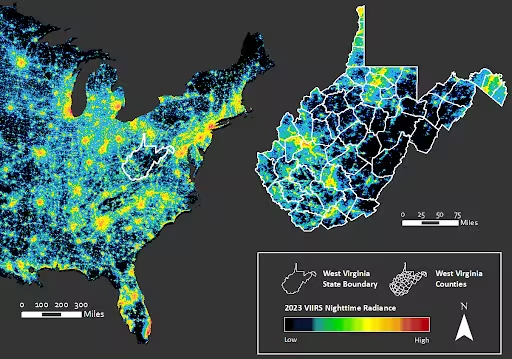
ALAN of the eastern United States and West Virginia (WVDNR SWAP 2025, Chapter 3).
Much of the eastern US is illuminated at night, leaving little refuge for wildlife that requires darkness. Larger areas of darkness in the eastern US are limited to areas like northern Maine, the Adirondacks in New York, and the Everglades in Florida. However, one of these dark blotches on the map lies in West Virginia! Therefore, the darkness of West Virginia night skies is important in the context of the region.
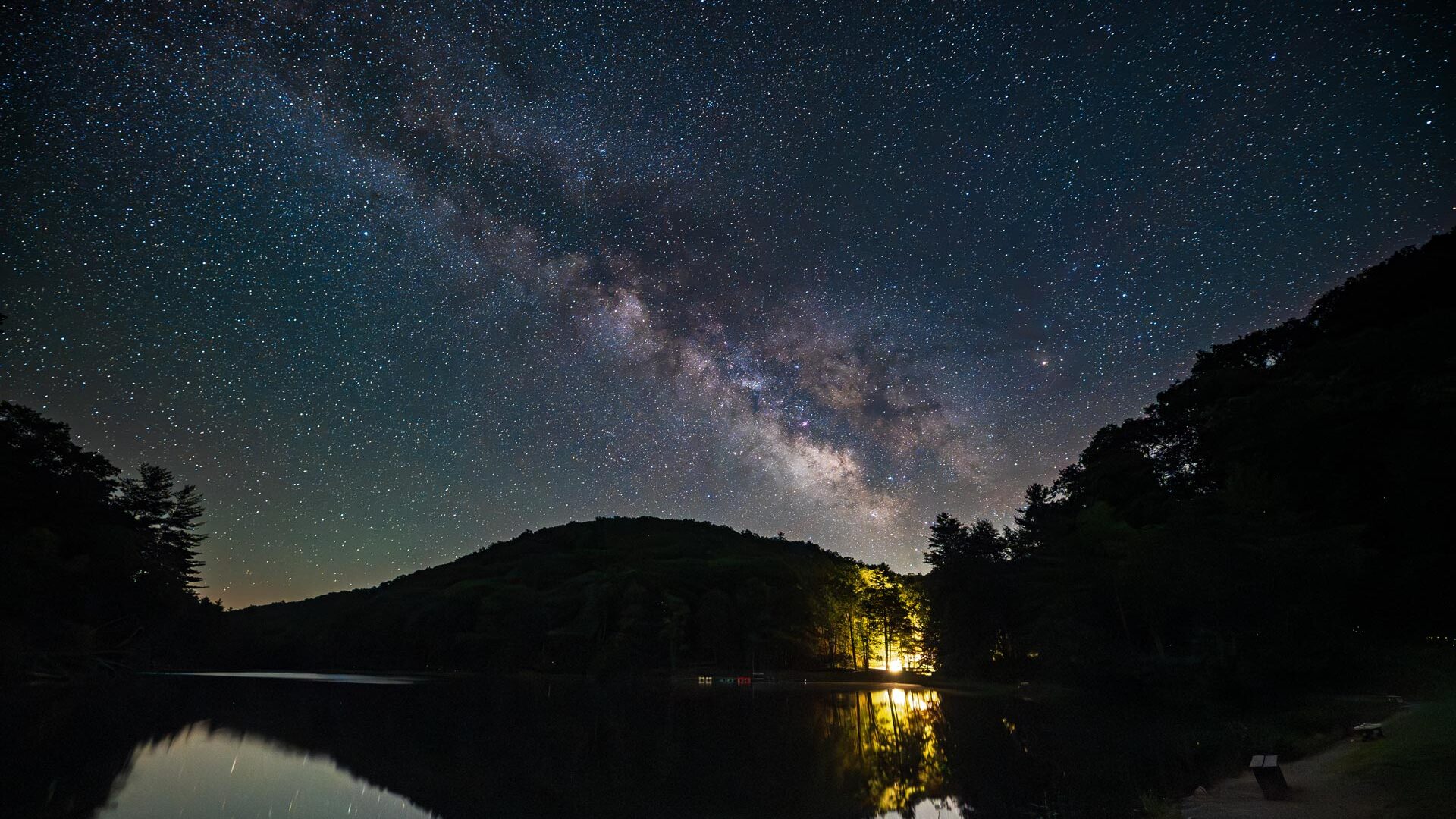
The darkest areas of West Virginia are largely in counties that contain the Monongahela National Forest, although there are small pockets of darkness in the west-central portion of the state. Moreover, West Virginia is home to three Dark Sky Parks certified by The International Dark-Sky Association (IDA): Watoga State Park, Calvin Price State Forest, and Droop Mountain Battlefield State Park. These three parks received IDA Dark Sky certification at the same time and represented the first locations in the state to receive the designation. Check out this article by Dark Sky International highlighting West Virginia State Parks!
What can you do?
There are several simple things you can do to mitigate ALAN at your home. Dark Sky International recommends following 5 principles for using outdoor lighting responsibly. Light should be:
- Useful
Have a clear purpose for your light. Use light only if it is needed.
- Targeted
Direct light downwards so that it falls only where it is needed. Use shielded light fixtures to direct the light downwards.
- Low Level
Use the lowest level of light necessary.
- Controlled
Employ the use of motion-sensors or timers to ensure that light is available only when it is needed.
- Warm-colored
Limit the amount of blue-violet light, and opt for warmer wavelengths.
What might enacting these principles look like in practice?
- Keep inside light inside by closing the curtains or blinds at night.
- Light only the areas that you need to be able to see.
- Still want the area to be illuminated when you arrive past dark? Consider using a motion-sensor light or a timer.
- Refrain from the use of dusk to dawn lights. Opt for motion sensor lights if you are concerned about home security risks.
- Replace light fixtures with downwards-pointed shades.
- Swap your blue-violet lights for warmer-colored, dimmer options.
- Do you have a flagpole? Avoid directing light upwards into the sky. Instead opt for a light fixture that sits atop the pole and casts the light downwards onto the flag, or refrain from lighting.
- Spending a summer evening on your porch? Turn the lights off when you go inside for the evening.
- Do you participate in a HOA or your neighborhood? Replace neighborhood lighting fixtures with downwards pointed light.
Mitigating ALAN at your home can be as simple as closing your curtains at night. Consider the strategy: “better, not more” when it comes to your lighting needs.
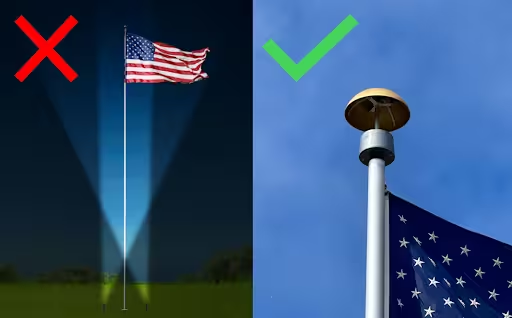
Avoid lights directed upwards and opt for top mounts that direct light downward.
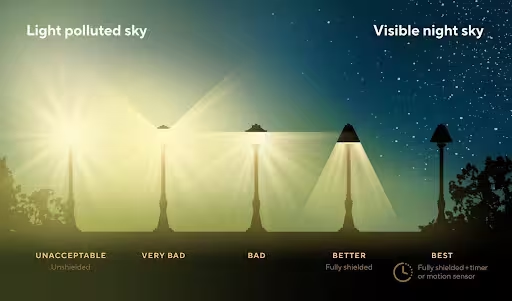
It’s best to use downwards shaded light. Source: Dark Sky International webpage
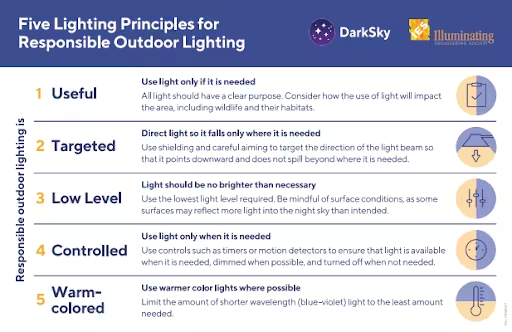
Source: Dark Sky International for responsible usage of outdoor lighting
It Takes a Village
Want to make community level changes? Consider the following:
- Suggest streetlight changes to your local government. These changes could include installing downwards cast light fixtures, properly shaded to avoid light trespass, or retrofitting streetlights to energy-efficient LEDs with adaptive controls. If you are an urban planner, consider these lighting designs in your planning as well!
- If you own a business with a parking lot, consider lighting the parking lot only during business hours. When business hours extend into the night, consider using downward shielded light that is no brighter than necessary to illuminate the space. If you run security tapes and require the light, switch to a sensor light that activates with movement.
- Lighting zones. Some cities have adopted lighting zones, where certain areas of the city have light restrictions to varying degrees.
- If you own a business that uses nighttime lighting to illuminate your sign, consider adapting the light for the sign to be downwards-directed, no brighter than necessary, and potentially turned off outside of business hours.
- Municipal restrictions on overly illuminated billboards.